
How to Search the Buffalo Court Docket
Missouri Case.net is the official entry point for a Buffalo docket search. Several routes work there. You can hunt by party name, by filing date, by case number or OCN, by scheduled hearings and trials, or through the judgment index. A court selector may appear. Pick the municipal or circuit scope that matches Dallas County and the 30th Judicial Circuit. A citation or case number is the best key. Stuck with only a name? Add a tight date range. Then use each result's court, county, case type, and status to rule out people with similar names.
- Open Case.net and select the search route that matches the Buffalo information in hand. Use a case or citation number first when one is available.
- Choose the participating court scope carefully. A Buffalo municipal result and a Dallas County circuit result are not interchangeable.
- Confirm the case header before reading further. Check the court, case number, filing date, category, and current status.
- Read the Buffalo docket entries for the charge or violation, setting, event code, disposition, and any public payment or compliance entry.
- If the search has no match, call the Dallas Circuit Clerk at (417) 345-2243 to ask about the current Buffalo division, case-number format, and custodian.
Never type a Social Security number or other sensitive identifier into a Buffalo case lookup. A blank result means one thing only: nothing matched in that scope and format. Spelling errors, older paper records, spotty municipal participation, a sealed file, or a different case-number format can all hide the answer.
Buffalo Code and Court Docket Clues
Buffalo's 2025 City Code points to a City Municipal Court. It also covers matters pending or unsettled there. That wording supports a municipal-court framework for the city. What it cannot do is name a current judge, give a clerk phone, list a docket day, publish a public calendar, set a fee schedule, or offer its own Buffalo court docket portal. The code explains a city rule. It does not decide how any individual Buffalo case turned out. Read the City Code for ordinance text. Then read the docket or ask the clerk for the actual case record. The official City of Buffalo website shows the city resources behind that framework.
The city site offers general resources and ordinance navigation. The docket route itself still runs through Case.net and the circuit clerk, not through a search box on the city page. That line matters when a Buffalo citation is involved. An ordinance may define conduct that falls under the municipal framework, yet the docket remains the chronological record of filing, setting, and outcome. A code page is not a certified judgment. And when you need proof of a result, a docket entry will not substitute for the underlying order.
The Buffalo Municipal Court
Buffalo sits as the Dallas County seat. It counted 3,290 residents in the 2020 Census. Its City Code uses the phrase City Municipal Court. Yet no separate public municipal-court portal or current court directory exists for the city. Under Missouri law, a municipal division operates as a division of the circuit court for city-ordinance matters. That explains a lot. A Buffalo municipal case often surfaces through the statewide system or a call to the county circuit clerk. The RSMo §479.020 municipal-division authority spells out that relationship.
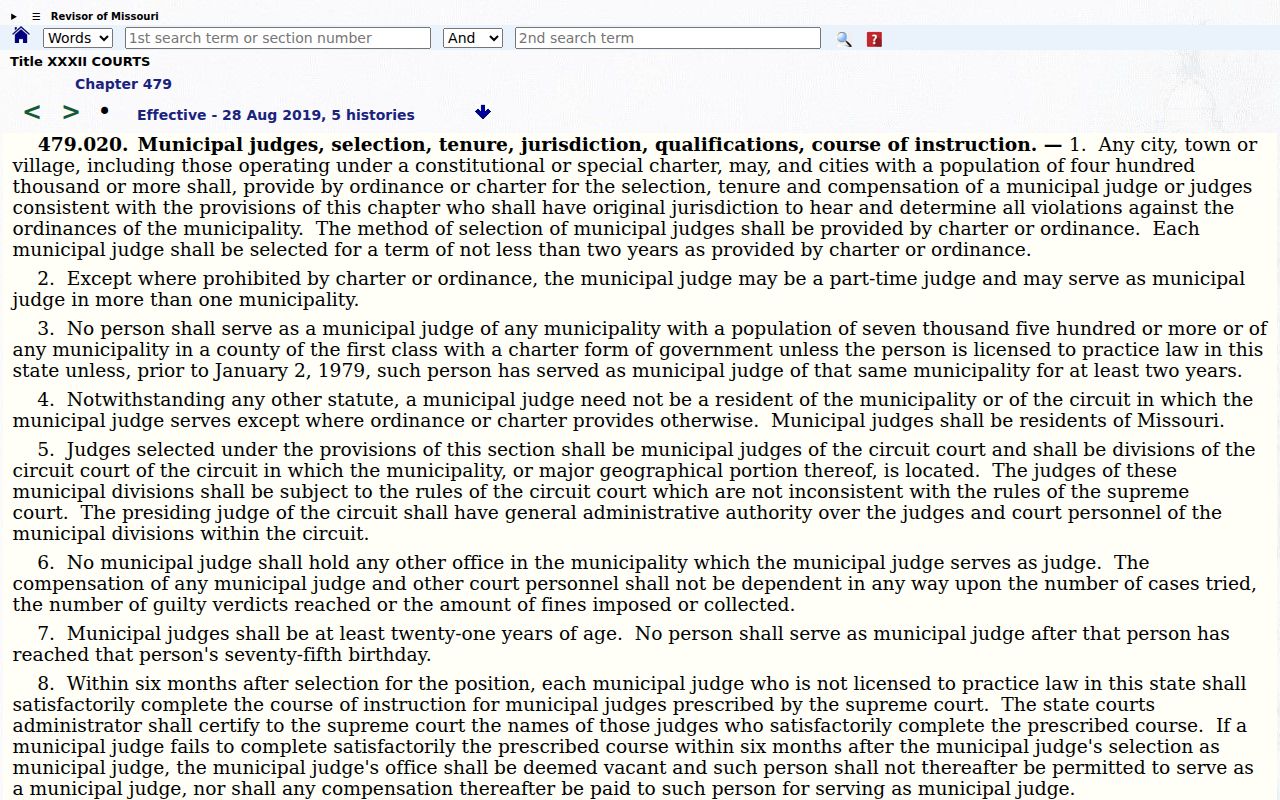
The statute fixes the legal tie between Buffalo municipal proceedings and the circuit system. It does not hand you a hearing schedule or a named court contact. So confirm those details case by case. Buffalo City Hall sits at 115 S Maple, Buffalo, Missouri 65622. Its listed phone is (417) 345-2701. Do not assume City Hall keeps the court file. The courthouse building sits at 108 S Maple. Despite the shared street, the circuit clerk counter and City Hall answer very different record questions.
Buffalo Citation Docket Event Codes
A Buffalo traffic or ordinance docket search goes smoother with the citation number. Keep it exactly as issued. The statewide municipal clerk manual says a uniform citation can serve as the case number. It also warns that one longer than nine digits may need clerk or court-system help rather than a guessed format. On a Buffalo docket, the citation, court scope, case category, and event sequence all work together. Never settle for a name match when a sharper case identifier exists.
The manual's event codes can help you read a Buffalo result. O5 marks municipal traffic. And O6 marks municipal other. These are a general official model, not a promise of what every Buffalo screen displays. AUTT means Uniform Traffic Ticket Filed. AINFO means Information Filed. A SCTR event is a traffic hearing, while SCHR is an ordinance-violation hearing.
Write down the citation number, the violation description, the event date, and the court shown. Keep a driver's license number, date of birth, home address, or any other private detail out of anything you publish from a citation. A public case lookup exists to find one record or setting. It is not a tool for building a dossier on a person.
Buffalo Court Dates and Settings
The citation or the case-specific notice wins over a general search result. That rule matters when checking a Buffalo court date. Case.net Scheduled Hearings and Trials can help if the court participates. Pick the Dallas or 30th Circuit scope. Set a date and period, then confirm the case number and the event. Settings shift, though. A continuance, reset, cancellation, or later order can move a Buffalo hearing after you find it. So recheck the case header and call the clerk before you show up. That step matters most when the Buffalo docket lists an older event and no clear future setting.
| Date | The scheduled date shown in the Buffalo case or hearing search, subject to later docket changes. |
|---|---|
| Time | The listed hearing time or docket-call time, not an assumed arrival time. |
| Courtroom | The location or division only if Case.net, the notice, or clerk confirmation supplies it. |
| Judge | The judge or commissioner field when displayed; no current Buffalo judge listing was located. |
| Setting Type | The event label, such as traffic hearing, ordinance hearing, trial, review, or another listed setting. |
A calendar row is not a notice. It can show a Buffalo hearing yet leave out the reason for the setting or a later result. When a result clashes with a notice, summons, order, or attorney notice, trust the case-specific document. Then get current direction from the clerk.
Buffalo Court Record Contact Routes
Buffalo's city and county offices do different jobs. City Hall is the practical route for city-government resources and ordinances. The Dallas Circuit Clerk is the documented route for a Buffalo docket. That covers court-system confirmation, public-terminal access, copy procedures, and current municipal-division routing. The State roster names the clerk as Susan Faulkner. It lists the clerk phone as (417) 345-2243. Keep the county-clerk office out of it. That office is separate, so a court-copy request should not land there just because it is easy to find. The Buffalo local-phone page is the official list represented in this Buffalo court record contact image.
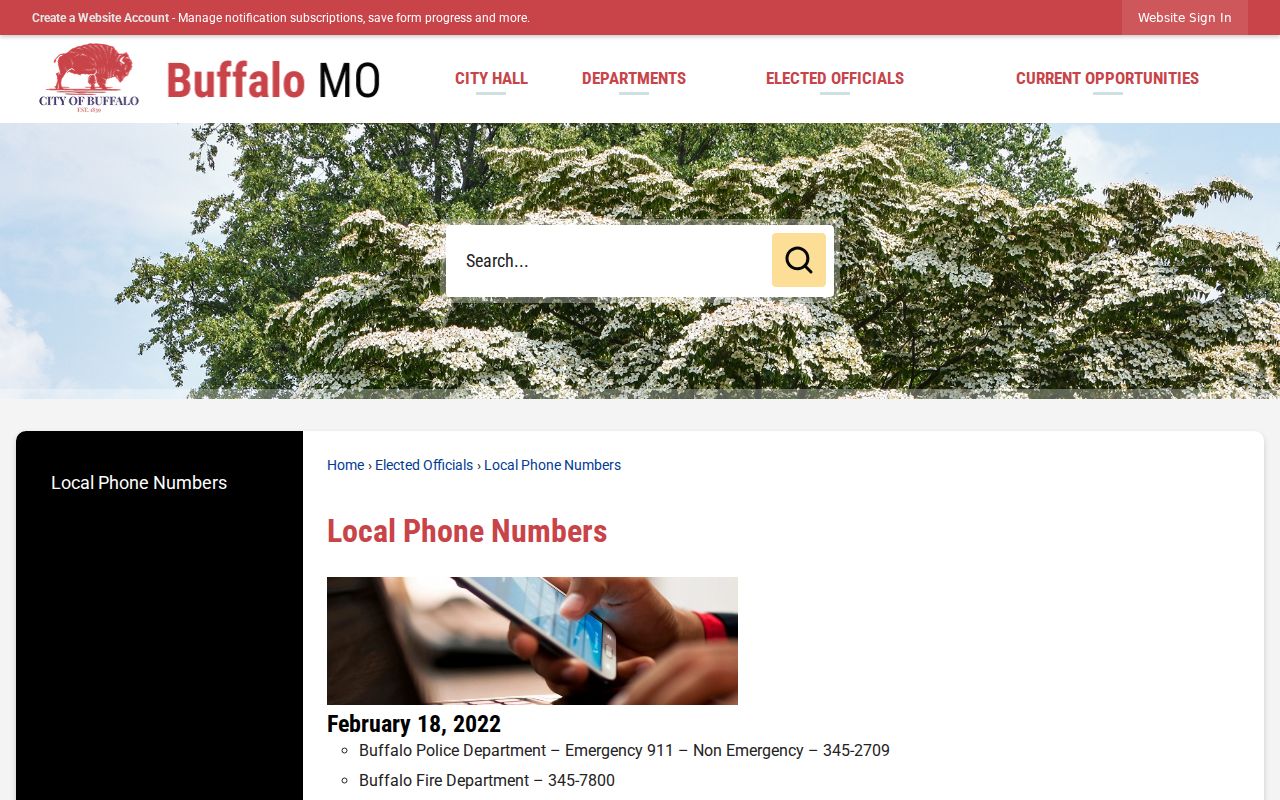
The local list helps with Buffalo routing. It does not prove City Hall holds a municipal case file. Ask the circuit clerk first. It can say which office keeps the specific Buffalo record before you make a request.
Bring the Buffalo case number for a courthouse visit. Without it, bring the full party name. Then add the approximate filing year, the case type or division, and the exact document you want. Courthouse staff may log a public user into the Case.net file viewer. Still, that does not mean every Buffalo document is open for remote download.
Buffalo Traffic Tickets
A Buffalo traffic ticket can stem from municipal, county, or state-law activity. Read the issuing information and the court category before picking a route. Search the citation or case number first. Then check the court and the violation description. Also check the hearing entry, the disposition, and any payment or compliance entry. A Buffalo traffic result can identify an event without proving a conviction. A disposition can mean dismissal, plea, or judgment. It may also record another outcome, so read the actual Buffalo docket language rather than guessing from a status label.
The citation and the court notice control the next step. They say whether a Buffalo charge can be paid or must go to a hearing. Case.net links to Pay By Web. That is the official channel. Confirm the exact Buffalo case is eligible. Confirm the payment route is official before you enter anything. Paying can carry legal consequences. Anyone wishing to contest a charge should contact the court promptly.
For the wider county-level context on tickets, use Dallas County traffic court records. The court docket and a Missouri Department of Revenue driving record are separate products. The docket records court events. The Department of Revenue controls the driving-history record and any license consequences.
Buffalo Ticket Payment and Compliance
Buffalo posts no official fine schedule, deferred-disposition program, defensive-driving program, or local compliance calendar. So ask the correct court for any Buffalo amount. Do not take a figure from an outdated directory or an unrelated Missouri schedule. Request the total fine and costs. Also ask about the accepted payment channel, the deadline, the receipt method, and how payment or compliance will appear on the Buffalo docket. If the case requires an appearance, payment instructions alone cannot replace the setting notice.
Missouri's municipal clerk manual sets a general copy ceiling of no more than 10 cents per page. It adds actual research-cost and duplication-time concepts. That generic rule is not a current Buffalo fee quote. State court-cost provisions also contain context-specific entries and should not become a flat Buffalo price. Ask the Buffalo custodian or the Dallas Circuit Clerk for the current amount. Do this before mailing money or requesting certification.
A missed Buffalo appearance or nonpayment can matter. RSMo §302.341 describes a notice process. It notes possible license consequences in qualifying traffic matters, subject to statutory exceptions and the posture of the case. Contact the court promptly instead of trusting an old Buffalo calendar entry.
Where Buffalo Cases End Up
Buffalo matters above the city-ordinance level may land in the Dallas County Circuit Court. That court is part of Missouri's 30th Judicial Circuit. Civil disputes, felonies, many misdemeanors, family matters, probate matters, and other statutory divisions are not interchangeable with a Buffalo municipal docket. Start with Buffalo municipal clues for an ordinance or city ticket. Then move to Case.net's Dallas or circuit scope. Do that when the category, court, or case number points to a county-level filing.
Docket flow: Buffalo Municipal Court › Dallas County Circuit Court › Missouri Court of Appeals, Southern District
Not every Buffalo matter ends when the circuit court rules. If someone appeals, the Missouri Court of Appeals, Southern District keeps its own separate record. That appellate file is separate. It sits apart from the circuit docket you just read. So check the court and the case type first. A Buffalo event only belongs on the Dallas County court docket under one condition. Both of those details must line up.
Buffalo Docket Gaps and Confirmation
Buffalo has no public docket page to pull up. That much is clear from the city's own setup. The Municipal Court is real, yet no official calendar, judge listing, remote-hearing page, copy form, or current fee list exists for it online. Treat those as gaps. Never fill them with a guessed schedule or an invented phone contact. Start with Case.net statewide. Then ask the circuit clerk whether a Buffalo division takes part. Ask which case format it uses. Ask where the live record lives.
One more thing worth knowing: a docket entry is not the same as the document behind it. Case.net can list a judgment as entered while the actual PDF sits at the courthouse, or stays sealed, restricted, or simply off-limits from home. The state's file-viewer help says public users may need courthouse access for some documents. And the Missouri eFiling System serves attorneys filing paperwork, not the public running a Buffalo docket search.
Note: Confirm any Buffalo search result with the court or clerk before you drive somewhere, pay a fee, or count on a date.
Public Access to Buffalo Court Records
Missouri treats court records as public as a rule. A Buffalo file is not wide open by default. What you can reach depends on the record type. It also depends on the court rule in play, and any sealing order. A docket may list the case number, the court, events, settings, and disposition. The matching document stays out of remote reach. Juvenile files, mental-health records, sealed or expunged matters, and protected personal details all face their own limits. Public access also never licenses you to publish a private address, birth date, license number, financial data, medical facts, or a protected identity pulled from a Buffalo file.
Before requesting a copy, name the right custodian. Say whether you want the Buffalo Municipal Court or the Dallas County Circuit Court. Give the case or citation number, the document and its date, plain or certified preference, your contact details, and how you want delivery. The city posts no official copy form, and no current certified-copy fee appears anywhere. Ask the clerk about fees and the proper office first. Then send the request.
Key Rules:
Missouri Sunshine Law, RSMo §610.011 supports public access to public records, subject to court rules and statutory exceptions.
RSMo §610.023 provides a response framework: a custodian generally responds as soon as possible and no later than the end of the third business day unless a reasonable delay is needed.
Court Operating Rule 4 governs Missouri court record systems, public access equipment, indexes, confidential material, and sealed records.
Buffalo Historic Court Record Searches
Very old Buffalo records often sit outside Case.net entirely. The Dallas County archives inventory points to County Court Docket series C 10316 covering 1875 through 1934, plus C 10317 covering 1934 through 1950, and neither is indexed online. There is also the County Court Record Index, series C 11085, whose index spans run from 1867 through 1949. These are leads into county history. They do not promise that every Buffalo case survives, or that a municipal matter landed in one particular series.
The Missouri State Archives County Records database lets you search or browse by county, office type, record type, keyword, city, and year. It is not a party-name index for everything. When you send a historic Buffalo request, include the rough year. Give the historical court name if you know it. Add the record series or docket number, the party direction that fits the record type, and whether you want a copy or to inspect in person.
Ask the Dallas Circuit Clerk one narrow question. Is the Buffalo record still held locally as a paper file? Does it carry a different historical number? Or did it move to the archives? That works far better than hoping a modern Buffalo case search doubles as a full archive catalog.